While imported greens fill shelves in grocery stores, they are often thought to outperform the humble ulam in nutrition, freshness, and affordability for generations. But, what if that’s not necessarily true?
Walk through any wet market in Ipoh, or Kota Bharu and you will find them. Neat bundles of pegaga, sprigs of ulam raja, glossy daun selom, and tightly rolled daun kaduk — all harvested that very morning, often from gardens just kilometres away. This is ulam: Malaysia’s oldest living salad tradition.
Yet in the same week, many of us will also spend two or three times more on a plastic bag of imported baby spinach or a head of broccoli flown in from Australia or China. Both are nutritious choices, but one has travelled thousands of kilometres to reach your plate. The other might grew in your neighbour’s backyard, often neglected.
What exactly is ulam?
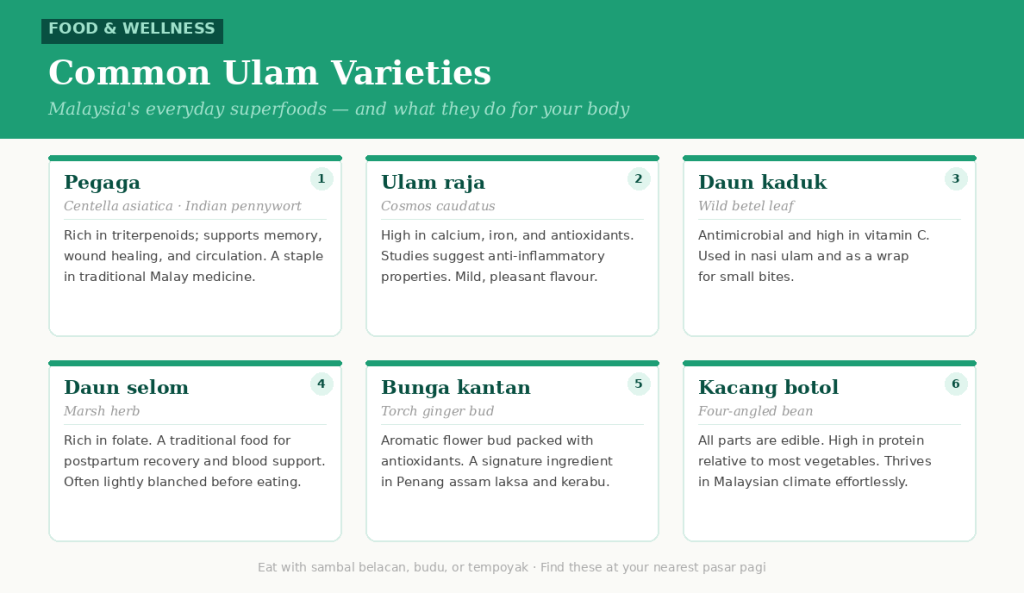
Ulam refers to any combination of raw or blanched leaves, shoots, herbs, flowers, and vegetables eaten as a side dish or salad — typically with sambal belacan, budu, or tempoyak as a dip. It is not a single plant but a whole category of eating, deeply rooted in Malay, Orang Asli, and Peranakan food traditions.
Common ulam varieties and what they offer
How ulam compares to imported greens
| Criterion | Ulam (local) | Imported greens |
|---|---|---|
| Carbon footprint | Very low — grown nearby | High — air or sea freight |
| Freshness at point of sale | Often same-day harvest | Days to weeks old |
| Nutrient retention | Higher — less transit time | Degrades with cold storage |
| Pesticide load | Often minimal or none | Varies; regulatory gaps |
| Price | Belom RM5/bundle | RM 5–15 per pack |
| Adaptability to local climate | Naturally suited | Requires controlled growing |
| Cultural familiarity | Generational knowledge | Requires recipe research |
This does not mean broccoli or kale are poor choices. They are genuinely nutritious. But framing them in a narrative that superior to local greens overlooks what our own food ecosystem already offers.
Consider the journey of a bag of baby spinach sold in a Malaysian supermarket. It is likely grown in China or Australia, harvested, chilled, packaged, freighted, cleared through customs, distributed to a cold chain warehouse, then trucked to the store — a process spanning 5 to 14 days. By the time it reaches your salad bowl, the water-soluble vitamins (B and C in particular) have measurably declined.
Meanwhile, a bundle of pegaga from the your nearby wet market was likely cut that morning. It costs a fraction of the price, requires no packaging, and carries phytonutrients that researchers are still actively studying for their benefits to cognitive function and metabolic health.
How to start eating more ulam
The simplest entry point is nasi ulam — steamed rice mixed with finely chopped herbs and a little dried shrimp. Beyond that, try a kerabu pegaga (pennywort salad with coconut and lime) or simply serve a fresh plate of mixed ulam alongside any rice meal as you would a salad.
If you are cooking for children or those unfamiliar with stronger herbal flavours, start with milder varieties like kacang botol, young pucuk paku (fern shoots), or cucumber — all technically ulam when eaten raw, before introducing pegaga or ulam raja.