Deep within the humid rainforests of Southeast Asia grows a fungus long regarded as both rare and remarkable. Lignosus rhinocerus, commonly known as Tiger Milk Mushroom, has travelled an unusual path from indigenous folklore to scientific laboratories, where it is now studied for its potential medicinal properties.
Often described as a “lost” or elusive natural resource, the mushroom occupies a unique position in Malaysia’s ethnomedicinal heritage and in the expanding global nutraceutical market.
Folklore and indigenous knowledge
Among Malaysia’s Orang Asli communities, Tiger Milk Mushroom has been traditionally associated with a vivid origin legend. Folklore recounts that the fungus emerges only at the precise location where a mother tiger’s milk falls to the ground while nursing her cubs. While symbolic rather than biological, the story reflects the mushroom’s perceived rarity and value within indigenous healing traditions.
From a scientific standpoint, the mushroom’s scarcity is well documented. Unlike many fungi that grow in clusters on decaying wood, Lignosus rhinocerus typically grows alone and develops from a sclerotium, a dense underground structure that can remain dormant for extended periods. The visible fruiting body is small and short-lived, contributing to the historical difficulty of locating it in the wild.
From botanical records to scientific attention
The species was first described scientifically in the late 19th century, appearing in European botanical literature as a tropical curiosity. For much of the 20th century, however, research remained limited due to inconsistent supply and the inability to cultivate the mushroom outside its natural habitat.
Public attention increased in the early 2000s when former Malaysian Prime Minister Tun Dr. Mahathir Mohamad reportedly mentioned using Tiger Milk Mushroom for respiratory discomfort. While such accounts are anecdotal and do not constitute clinical evidence, they coincided with renewed academic and commercial interest in the fungus.
Subsequent advances in biotechnology, particularly in tissue culture and controlled cultivation techniques, enabled more reliable production. This development marked a turning point, allowing researchers to study the mushroom’s chemical composition and biological activity under standardized conditions.
What research currently indicates
Scientific studies to date suggest that Tiger Milk Mushroom contains a range of bioactive compounds, including polysaccharides, beta-glucans, and protein–polysaccharide complexes. Research has largely focused on three areas:
Respiratory health
Laboratory and animal studies indicate anti-inflammatory effects that may be relevant to respiratory conditions. Extracts have been observed to influence immune pathways associated with allergic and inflammatory responses, supporting its traditional use for coughs, asthma, and bronchial discomfort. However, large-scale human clinical trials remain limited.
Immune modulation
Rather than acting as a general immune stimulant, compounds within the mushroom appear to have immunomodulatory effects, meaning they may help regulate immune activity. This distinction is important, particularly for individuals with immune sensitivity, although further clinical validation is required.
Anti-proliferative activity
In vitro studies have demonstrated that certain compounds from Lignosus rhinocerus can inhibit the growth of selected cancer cell lines. Researchers caution that such findings are preliminary and cannot be directly translated into therapeutic claims without rigorous human trials.
From forest floor to global market
Today, Tiger Milk Mushroom has moved beyond its status as a rare jungle find. It is now incorporated into commercially produced supplements, powders, and functional beverages, particularly within Asian wellness markets. Malaysia, in particular, has positioned the fungus as part of its natural heritage with export potential.
As interest in integrative and evidence-based traditional medicine grows, Tiger Milk Mushroom represents an intersection of indigenous knowledge and modern scientific inquiry. While research continues to evolve, its story highlights a broader theme: many traditional remedies, long overlooked, may still hold biological insights worthy of careful and critical exploration.
Tiger milk mushroom: Botanical profiling
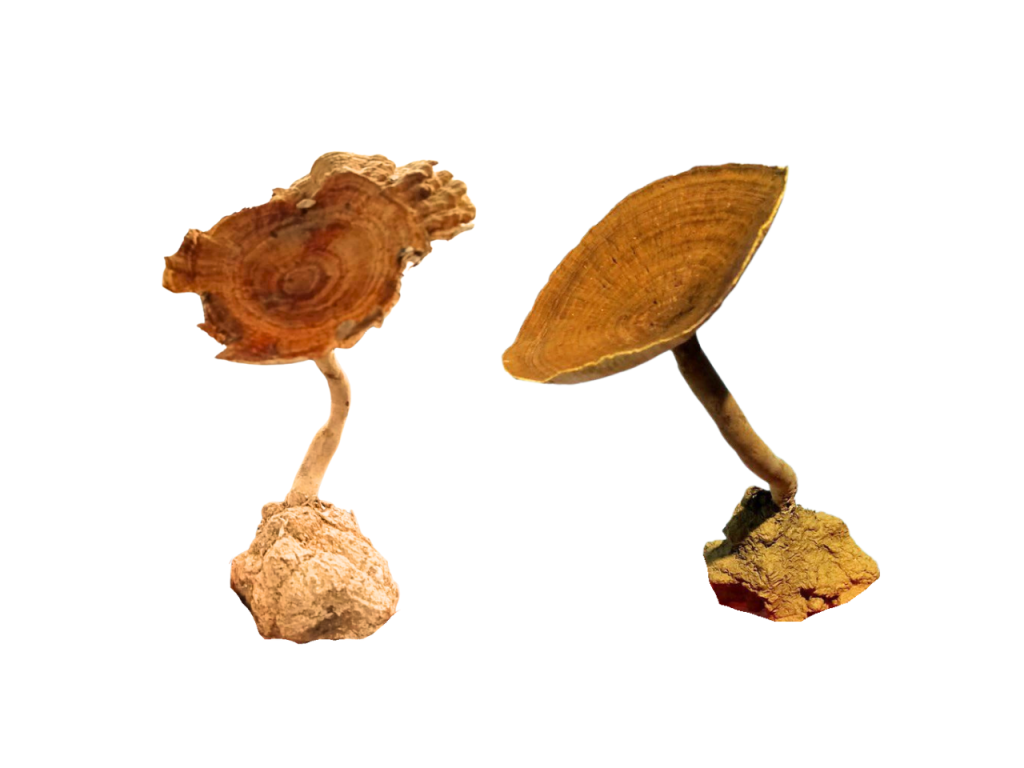
Common Name: Tiger Milk Mushroom, buy here
Scientific Name: Lignosus rhinocerus (Cooke) Ryvarden
Kingdom: Fungi
Family: Polyporaceae
General Classification:
- Medicinal fungus, often culturally grouped with plants due to subterranean growth habit and traditional use
- Non-photosynthetic; lacks chlorophyll
Growth Form:
- Saprotrophic fungus growing from decomposing woody material
- Naturally rare and sporadically distributed
Key Morphological Feature:
- Sclerotium:
- Subterranean, tuber-like survival structure
- Dense, globose to irregular in shape
- Serves as nutrient storage and stress-resistance organ
- Often hidden beneath soil or forest litter
Stipe:
- Slender and elongated
- Pale to brownish in colour
- Emerges vertically from the sclerotium
Pileus (Cap):
- Circular to fan-shaped
- Displays concentric growth rings
- Colour varies from ochre to deep brown
- Texture firm and woody
Hymenial Surface:
- Poroid (no gills)
- Adapted for gradual spore dispersal in humid environments
Habitat:
- Lowland tropical rainforests
- Prefers shaded, moist environments
- Associated with well-decomposed woody substrates
Geographical Distribution:
- Southeast Asia, particularly Malaysia and surrounding regions
Ecological Role:
- Decomposer contributing to nutrient cycling within forest ecosystems
Buy here
This article contains affiliate links. That means we earn a small commission if you decide to buy, without any extra cost to you. Helps support our writing and keep sharing free content like this.